Welcome To The Global Breaking News - Teoh Beng Hock Inquest LIVE From Shah Alam Court Altantuya Murder Case !!! Are them the real killers??? ... EPL 2009/10 Results !!! Che 3-Bur 0, Blk 0-WHU 0, Bol 2-Liv 3, Stk 1-Sun 2, Tot 2-Bir 1, Wol 1-Hul 1, MU 2-Ars 1, Por vs MC , Eve vs Wig , Ast vs Ful ...
Custom Search
Hurry!!! English Premierleague is about to start on 15 August 2009. Register FREE your SOCCER team now at www.fantasy.premierleague.com and join Liga Oversea. The code to joint is 535557-119371
Showing posts with label Datuk Seri Anwar Ibrahim. Show all posts

Saturday, April 18, 2009

Anwar challenge Najib to give walkover at Penanti

Permatang Pauh : Opposition Leader Anwar Ibrahim has challenged Prime Minister Najib Razak to give a walkover at Penanti, where a by-election is due to be called following the resignation of its assemblyman Fairus Khairuddin.


“I call upon the BN and Umno leadership not to field any candidate against Keadilan in the Penanti by-election and give us a walkover.


It will not only save taxpayers’ money, time and energy, but also will be consistent with the PM’s statement,” Anwar said at a late-night address at his Permatang Pauh constituency.


Najib had accused Anwar of playing political games and ‘deliberately’ forcing the Penanti by-election.


The prime minister’s Umno -BN coalition has lost four out of five by-elections to Anwar’s Pakatan Rakyat since March 2008. His supporters believe that he cannot afford to lose another - not without severe backlash from rivals within his own Umno party.


Said Najib: “The people generally do not like by-elections that are held deliberately. There is so much time, energy and money being spent on by-elections that we do not even need.”


Meanwhile, taking the cue from Najib, the Election Commission said it would need time to study in detail whether a vacancy had occurred and the circumstances of the case before responding.


EC chairman Abdul Aziz Mohd Yusof told reporters his commission would meet on Wednesday, Apr 22, and announce its decision only on Friday, Apr 24.

This is not the usual Umno-BN wastage, this is for Penangites


Fairus quit his state assembly seat on Thursday, a week after stepping down as deputy chief minister of Penang as allegations of corruption mounted against him.

The Malaysian Anti-Corruption Commission announced last week that investigations were completed and that it would be forwarding the case to its prosecution department.


Penang Keadilan chief Zahrain Mohamed Hashim said Fairus had made the decision to quit, and as such, his wishes should be respected by all quarters, including Najib.


“I am sure Fairus has good reasons for resigning, and I am also sure that Anwar has been briefed about it,” said Zahrain.

Meanwhile, political watchers believe it was important for Pakatan to ensure that Penang got the best political leaders possible, and if that required a democratic by-election, then so be it.


The by-election costs involved were negligible in comparison to the huge sums swallowed by the powers-that-be in Malaysia’s highly-corrupt political scene, they added.


“Fairus may not be charged, but the party and public interests must come first. I respect his wish to resign and the party will protect and safeguard his interests. We will provide the necessary legal defence for him,” Anwar had said.


A Malay heartland


Penanti is one of three state seats under the larger Permatang Pauh parliamentary constituency, held by Anwar.

In the 2008 general election, first-timer Fairus thumped his rival by obtaining 7,346 votes. Abdul Jalil Abdul Majid, who carried the Umno-BN flag, only managed to gain 5,127 votes, giving Fairus a 2,219 majority.


Located on the mainland, Penanti boasts a picturesque expanse of padi fields, with rubber and palm oil plantations dotting the constituency.


It is made up of little villages with a smattering of commercial activities. Most of the residents are industrial workers and small businessmen.


There are 15,421 voters, of whom 11,296 or 73 percent are Malay, 3,732 or 24 percent are Chinese, and 371 or 2 percent Indian. (SK)


Click this link to read more!

Saturday, April 4, 2009

People still unhappy despite 13 ISA to be released - Anwar

Supporters in Bukit Selambau are all ears as Anwar points out the inconsistency in the release of the 13 ISA detainees. — Picture by Shannon Teoh

By Shannon Teoh

BUKIT SELAMBAU, April 4 — There was no let up in Datuk Seri Anwar Ibrahim's attack on Datuk Seri Najib Razak's first day as prime minister with the opposition leader finding inconsistencies in the latter's decision to release 13 Internal Security Act detainees.


Just three hours after Najib had announced the release of two Hindraf leaders and 11 others, Anwar told 5,000 supporters in Bukit Selambau that so long as the ISA existed, Barisan Nasional could still detain citizens at will.


"Pakatan Rakyat still protests against this draconian law. They can still detain, then release, detain and release. Where is the justice? What kind of government is this?" he said last night.


The PKR de facto leader also played down the significance of the move, no doubt conscious of the effect it could have on the three by-elections on Tuesday.

"Yesterday they were terrorists, today they are innocent. Do not forget Tun Hussein Onn and Tun Dr Mahathir Mohamad did the same, but then more were detained later," he reminded the audience.


The Permatang Pauh MP added that this flip-flopping was symptomatic of the Umno-led BN.


"When we said the RM7 billion economic stimulus package was not enough, they said, no, this is enough. Then Najib announced a new RM60 billion plan and they said we support it. When the government called the detainees terrorists, they supported. Now it says they are suddenly innocent and they also support."


Speaking to reporters later, he clarified that he welcomed the release of the 13 detainees but criticised the statement that the law will be studied.


"It was meant to stop militant communism and should have been repealed once it was resolved. There is no rationale to start studying now. It should simply be repealed immediately," he said.

He also brushed aside suggestions that the release of two Hindraf leaders would affect the loyalties of Indian voters who make up 30 per cent of the electorate in Bukit Selambau.

"The release of Hindraf leaders is just one of the demands of the Indian community. For as long as they are still treated as second-class citizens, BN should not think that all the problems are over," he said.


Anwar also insisted that the ISA releases would not have a significant impact on the three ongoing by-elections as all newly installed prime ministers did so and PR had already accounted for it in its plans.

While he refused to speculate on the intentions behind the release, he said the government should not "use it to delude the people that injustices can continue to be perpetrated."


Earlier, Kedah Menteri Besar Datuk Seri Azizan Abdul Razak also moved to refute the notion that his government has not brought any improvements in the 13 months since PR took over the state.

It comes on the back of some electoral groups in Bukit Selambau making known that they are unhappy with the running of the state government.

He reminded those present of the RM83 billion Kedah Hidrocarbon Hub and announced that the megaproject would take off in July.

"By 2013, oil refining will bring the state RM400 million a year," he said, adding that it would increase to RM600 million to RM800 million a year by the next year.


The PAS leader said his only worry now was that his government would be destabilised before the project could begin to produce returns and urged Bukit Selambau to elect S. Manikumar.

He praised the PKR candidate and pointed out that his MBA and good business acumen would be an asset to the state executive council as he was assured the appointment should he win on Tuesday (TMI)


Click this link to read more!

Wednesday, March 11, 2009

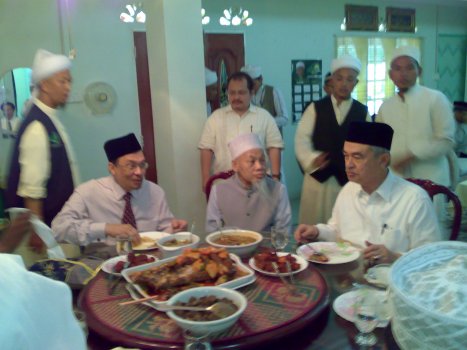
Pak Lah & Anwar historic lunch in Hulu Langat

KUALA LUMPUR: Prime Minister Datuk Seri Abdullah Ahmad Badawi and Opposition leader Datuk Seri Anwar Ibrahim had an unexpected meeting at a religious school in Hulu Langat, near here, yesterday.

News websites and political portals reported that both of them had been invited by well-known Ustaz, Sheikh Mahmud Al-Mazjub to celebrate Maulidur Rasul at his Madrasah Nurul Iman, Hulu Langat, Selangor.

The portals said there were over 1,000 people at the function who were surprised at the visit of the two men.

Abdullah is said to have arrived about 20 minutes before Anwar and PKR president-wife Datuk Seri Wan Azizah Ismail.

Pictures on the portals showed that Abdullah and Anwar also had lunch with Sheikh Mahmud. The three of them also performed zohor prayers at the school.

Their unexpected meeting raised eyebrows and led to all sorts of speculation on the Internet.

However, Anwar said in his blog that there had been too many assumptions and interpretations over their presence at the function.


Click this link to read more!

Friday, December 26, 2008

Pressure on Anwar to clarify stand on Hudud Laws

KUALA LUMPUR — More voices have joined the roiling debate over hudud, with Wanita MCA adding to the number of those calling for Opposition Leader Datuk Seri Anwar Ibrahim to clarify Pakatan Rakyat’s (PR) stand on the matter.


Earlier today, DAP chairman Karpal Singh had also repeated his call for Anwar to “break his silence, as DAP has done so” with regards to the support for hudud by Pas, the third partner of the coalition.


Pas vice-president Datuk Husam Musa had said that the Islamist party has not forgotten its aim to implement hudud, which prescribes amputation, whipping and stoning for criminal offences, should it come into power.


When DAP criticised the statement, Pas spiritual leader Datuk Nik Abdul Aziz Nik Mat challenged DAP to make its case as to why hudud laws are not acceptable.

“Husam’s statement has resulted in anxiety among non-Muslims in the country. Pas firmly insisting on introducing hudud has ignored the fact that Malaysia is a multi-racial and multi-religious country and the spirit of Federal Constitution”, Wanita MCA chief Datin Paduka Chew Mei Fun said today.


Given that Karpal and DAP secretary-general Lim Guan Eng have already asked Anwar to clarify, Chew said that the de facto PKR leader must “respect the request of the two DAP leaders and respond to Husam's remark accordingly.”


“If Anwar decides to keep quiet, there are only two possibilities, one; Anwar agrees with the remark made by Husam to implement hudud or DAP has been marginalised in PR,” she said.


Karpal had this morning said that the backing of hudud was hurting Pas's credibility and it should be more careful about breaking ranks in the future.

He reminded reporters of the electoral alliance in 1999 where Pas had agreed not to include the formation of an Islamic state in the manifesto.


However, two days before the election, Pas announced it would establish an Islamic state if it took over the state government of Terengganu. Karpal insisted that this proclamation had cost many DAP leaders, including himself and Lim Kit Siang, to lose in the general elections.


With that in mind, he said that DAP had limited “political patience” but was satisfied for now that Husam has backtracked in stating that Pas must obtain a consensus from its PR partners.


“We will still campaign and give our full support to whichever candidate is selected for the Kuala Terengganu by-election,” he assured. (TheMalaysianInsider)


Click this link to read more!

Friday, November 7, 2008

Judge rules against AG in Anwar sodomy trial

Kuala Lumpur : Opposition Leader Datuk Seri Anwar Ibrahim has won the first battle in his Sodomy II trial.Today, the Kuala Lumpur Sessions Court judge S M Komathy ruled the certificate signed by the Attorney-General requesting the case be transferred to the High Court was ruled invalid.

This will give a fillip to Anwar's fight against the sodomy charge which he has denied and suggested is politically-motivated.

Komathy ruled today that there is a legitimated expectation in Prime Minister Datuk Seri Abdullah Badawi's promise that the AG would not be involved in Anwar's trial.

The PM had made the promise because Anwar has complained that the AG and the Inspector-General of Police had conspired to destroy evidence during Sodomy I ten years ago.

Anwar has claimed trial to the charge of sodomising his former aide Mohd Saiful Bukhari Azlan.

MORE TO COME

Click this link to read more!

Friday, October 24, 2008

Alternative Budget 2009 unveiled by PR

Pakatan Rakyat today unveiled what is seen to be their ‘alternative budget’ containing a wide range of promises and recommendations specifically to tackle the current global economic crisis.

The 20-page statement titled ‘Facing economic challenges and rebuilding confidence’ was read out by Opposition Leader Anwar Ibrahim at a press conference in Parliament this morning.

Also present were several Pakatan MPs, including DAP supremo Lim Kit Siang and PAS secretary-general Kamaruddin Jaffar.

Anwar told reporters that the Budget 2009 tabled on Aug 29 by Prime Minister Abdullah Ahmad Badawi, in his capacity as finance minister then, was “deeply flawed”. Deputy Prime Minister Najib Abdul Razak took over the finance portfolio later.

The nation’s leaders seem to be on auto-pilot, unaware of the challenges which have already risen in the form of runaway inflation, rising unemployment and declining foreign investment.

“More troubling is their prolonged state of denial over the grim economic forecasts,” Anwar said.

Re-engineering the growth strategies

He explained that Pakatan’s various recommendations were therefore made in the light of the global economic and financial crisis, the sharp decline in commodities markets and the anticipated impact of these factors on the Malaysian economy.

To address this, Anwar said the broad thrust of the policy would be directed at re-engineering the growth strategies for the immediate and long term and to address the vulnerabilities in the economy.

He proposed the four main strategies to be ensuring the stability of financial markets; enhancing provisions for the social safety net; maintaining domestic price stability and enhancing national competitiveness.

Some of the key recommendations - such as the auction of approved permits and the reforms of public tender system - have been made by the opposition leader in a 11–page economic policy paper last month in response to Budget 2009.

Although the recommendations made by the opposition alliance was similar to its alternative budget in previous years, Anwar and Lim nevertheless denied the document released today was Pakatan’s alternative budget.

They said this when asked why Pakatan only chose to unveil the recommendations today - the last day for the debate on Budget 2009 in Parliament.

“We don’t call it alternative budget. This is our plan in order to meet the crisis of confidence on the economical front and we give various specific measures addressing specific problems facing the country,”explained Lim.

The salient points

The salient points from the measures proposed by Pakatan today include:

* Pakatan anticipates a decrease in government’s revenue by 11 percent to approximately RM157 billion as against the government’s projection of RM176 billion due to the drop in commodity prices as well as a decline in GDP.

* Suggestion for a 15.5 percent reduction in government’s operational expenditure to RM130 billion, as opposed to the government’s proposed amount of RM154 billion. In reducing operating expenditure, Pakatan assures it will however make no reduction in government salaries.

* Pakatan believes that a RM10 billion substantial savings is feasible simply by reducing corruption and mandating open-tenders for government procurement.

* Pakatan believes the budget deficit to be 3.0 percent, down from the estimated 3.6 percent for 2009, based on the revised calculation of revenue and allocation for expenditure.

* Education, public transportation, health and housing were chosen as the four areas to be benefit from substantial increases in development expenditure. The allocation for education to be increased from RM8.4 billion to RM11.8 billion in 2009, RM3 billion for housing development as opposed to the government’s RM1.4 billion and RM3.5 billion for improving security.

* Set up the Independent Police Complaints and Misconduct Commission (IPCMC) and re-allocate approximately 30 percent of the police officers from administrative departments to crime-fighting.

* The approved permits for imported vehicles are suggested to be auctioned to highest bidders in order to generate an estimated additional RM1.75 billion to government’s coffers.

* Renegotiation of “exploitative contracts” in toll concessionaires and the independent power producers for a lower cost of services to all Malaysians and savings for the government.

* A temporary reduction in employee contributions to the EPF from 11 percent to nine percent for a period of one year to increase disposable incomes. This would inject nearly RM2 billion of disposable income into the economy for domestic spending.

* Liberalising taxes and import duties on inputs used for the production of food, final goods and farming.

* The formation of a pricing mechanism which is more responsive to fluctuations in market price for crude oil.

* The enactment of a national competitiveness policy and take steps to reduce the “unfair market power” held by state-created monopolies”.

* To revitalise the SMEs sector, it is proposed that the tax rate for SMEs on their first RM500,000 chargeable income be reduced to 18 percent from the current 20 percent. A new partial tax exemption threshold is also proposed and to set at RM200,000 and taxed at 12 percent.

* A review for mega project costing more than RM1 billion to assess their socio-economic viability, affordability and intended impact on national development and employment.

* All government contracts to go through public tender. A saving of at least RM5 billion per annum is estimated to be achieved from this.

Click this link to read more!

Tuesday, October 14, 2008

Please investigate Najib's power abuse - Anwar

Opposition leader Datuk Seri Anwar Ibrahim has called for investigations into the alleged abuse of power by Datuk Seri Najib Razak.

The deputy prime minister is facing renewed links to the murder of Mongolian beauty Altantuya Shaariibuu.

Malaysia Today carried a report detailing what it alleged was an exchange of text messages between Najib and Datuk Shafee Abdullah, the prominent lawyer who represented Abdul Razak Baginda, the close associate of Najib who was eventually charged with abetting two police officers in the murder of Altantuya in 2006.

In one SMS, Najib allegedly tells the lawyer that Razak — his advisor — “will face a tentative charge but all is not lost”.

Malaysia Today said this message raises some questions about Najib’s role in the case. “Why did he mention ‘tentative’ charge and that ‘all is not lost’ for RB (Razak Baginda)? How would Najib know this before Razak was charged? These are important questions which will have ramifications, not just on this case but far beyond,” a posting on the website said.

Anwar and the opposition have tried to link Najib and his wife Datin Seri Rosmah Mansor with the murder since it happened in October 2006.

“Any allegation, particularly pertaining to those in positions of power, must be investigated,” Anwar told reporters in Parliament today.

“Our problem is that allegations against Najib, from the murder to the Scorpene submarine and Eurocopter deals and to these SMSes, have not resulted in any investigations or reports,” he pointed out, referring to allegations of graft in Defence Ministry contracts when Najib was its minister.

The de facto PKR leader said this “shielding” of Najib would affect the credibility of the government.

“How do you accept a leader who is not even prepared to explain? Of course you can go to the mosque and swear on the Quran but that does not solve a serious allegation,” he said in reference to Najib’s oath that he did not know Altantuya personally.

He added that he was not suggesting that Najib was involved but it should be investigated instead of just brushing the matter off.

Altantuya case SMS link
Eurocopter Scandal link


Click this link to read more!

Monday, October 13, 2008

New Govt will be formed at suitable time - Anwar

Datuk Seri Anwar Ibrahim refused to rule out the possibility of a no-confidence vote against the government in Parliament when it reconvenes tomorrow.

"Well, wait for tomorrow," the Opposition Leader said when asked if he had planned any surprises for tomorrow.

The opposition had attempted to table such a motion in July but it was denied by the Speaker.

Speaking at his open house at the Sultan Sulaiman Club in Kg Baru today, he also clarified that he has not given any new specific date for the takeover of federal government.

"I did not give a date for takeover. I said I will continue to take necessary steps. At a suitable time, we will witness the change," he said when quizzed about reports that he had set Dec 8, Hari Raya Haji, as a new deadline in a speech in Kelantan.

In the immediate aftermath of the March 8 general elections, the former deputy prime minister had insisted that the takeover would happen by Malaysia Day on Sept 16.

He has since continued to claim that Pakatan Rakyat has the support of enough Barisan National MPs who will join its 81 MPs to gain majority control of Parliament.

After the Sabah Progressive Party pulled out of Barisan Nasional, the governing coalition lost two MPs and PR now needs to add 29 of Barisan Nasional's 138 MPs to topple the government.

The Permatang Pauh MP also brushed away the insistence by leaders of the dominant Umno that his claims were merely attempts to destabilise the governing coalition.

"I don't care about the accusations and claims of Umno leaders. It has happened many times.

"They said March 8 was impossible, to increase the majority in Permatang Pauh was also impossible.

"So we have proved that the people want change. If MPs and the people want change, no power can stop this," he declared.

He elaborated that takeover plans would "respect the constitution and the legal and parliamentary process."

"We have to accept the possibility of a change by a vote of no-confidence or MPs refusing to support the government," he said, giving the example of Datuk Zaid Ibrahim, who recently resigned as de facto Law Minister.

"He resigned as a matter of principle against the use of the Internal Security Act. What if he decides to join PR? Is that unlawful? Is that unconstitutional? Is that unethical?"

Anwar added that he believes more MPs will "realise that political stability is paramount and cannot be handled by Umno... ethnic relations have worsened and we need to change... not through arrogance of power and racist remarks.

"We have to deal with the economy. It has been mismanaged and they are in a state of denial and refuse to accept the economy is shattered," he claimed and stated that these were adequate reasons and rationale for PR to garner more support.


Click this link to read more!

Thursday, October 9, 2008

Pak Lah gracefully forced out - BBC

Abdullah Badawi said he had not been forced out.

When I asked him if he regretted being pushed, he gestured to the man sitting beside him, his deputy and heir Najib Razak, and to the other politicians around him from the ruling coalition.

He said: "Ask them if they have forced me out." A few shook their heads but Malaysia's fifth prime minister is not leaving office in March 2009 because he wants to. He is leaving because he has to.

There are still a few months to go but the epitaph will not be kind.

"He was weak, he was reluctant to do things which he should've done," says Chandra Muzaffar, a political analyst and academic.

After promising so much in 2004 when he secured a record victory at the polls, Dr Muzaffar believes Abdullah Badawi squandered a mandate for reform because he could not deliver.

"There is, I think, a personality factor at play - the reluctance on his part to antagonise people, to do things which a reform-minded prime minister will have to," he says.

'Power first'

The man who is almost certain to succeed him has been groomed for the job from the day he was born.
"The government under Najib will be ruthless"
Anwar Ibrahim
opposition leader

Najib Razak is the son of Malaysia's second prime minister. He has been in parliament since his early 20s.

"People expect him to be tougher," opposition leader Anwar Ibrahim told the BBC.

"The government under Najib will be ruthless."
He believes that little will change come next year when the handover takes place.

"Nothing is resolved, he is surrendering to a person who is badly tarnished," he told me.

That is a reference to sensational claims that the deputy prime minister was involved in the murder of a woman.

Najib Razak has strongly denied the allegation.

One of his closest advisors is on trial for the killing.

In an interview with the BBC last August, he did admit that there had been questions about his reputation but said: "I think I have cleared my name... my conscience is clear."

There are those who see this British-educated economist as the insider who can bring about change.

"Najib knows that if Umno [the United Malays National Organisation] and the Barisan Nasional [National Front] don't change, in the short term, they will be in deep trouble," says political analyst Dr Muzaffar.

But he believes that he will not promise a raft of radical reform, like the changes Abdullah Badawi promised for the judiciary and the corruption agency, adding:

"What impels him to bring about change is not so much a commitment to reform as a commitment to power."

Fatal slip

The reason Abdullah Badawi is going is because he came close to losing power.

In Malaysia's 51-year history that has never happened.

The same side has been in charge from Day One.

The country had continued its impressive economic growth under his watch.

But divisions which have haunted this multi-racial and multi-religious nation at times bubbled to the surface once more.

When his second general election as leader came around earlier this year, the people punished him.

Malaysia's minority Chinese and Indians deserted the government in droves. The prime minister was humiliated. The Barisan Nasional won but with a much reduced majority. Support for the opposition swelled to unprecedented levels.

In the days and weeks after the result, Abdullah Badawi faced down his critics.

Then came the first sign of mounting dissent in the ranks.

He agreed to hand over to his number two in 2010. That failed to allay the fears of those who thought the government was doomed unless it changed leader and direction.

So after months of in-fighting he is going, much earlier than he said he planned to go.

"In all my years of service, I've always been guided by my conscience - I've always placed the interests of the nation above all," Abdullah Badawi said as he announced his decision.

"It is with this in mind that I announce I will not be standing... in the coming party elections."

He said he was going to ensure unity.

End of the road

Unity is a crucial theme in Malaysia. This is a country of different races, different religions, with people of vastly differing wealth. For 51 years it has remained mostly stable and peaceful, but fundamental problems remain.

The increasing role of Islam, the religion of the Malay majority, worries the country's 35% non-Muslims.

A decades-old economic policy which gives preferential treatment to Malays still causes bitterness and anger. Malays can jump the queue for university places, government jobs and housing.

Abdullah Badawi's reign will stretch to almost six years by the time he steps down but he may be remembered most for events in the final months.

With an invigorated opposition threatening to take power, the prime minister and his government resorted to desperate acts.

An opposition member of parliament, a journalist and a prominent blogger were arrested and detained under strict security laws. They were deemed a threat to national security.

Anwar Ibrahim is facing a trail for sodomy, an accusation many believe is fabricated and politically motivated.

Malaysia is at a "historic crossroads" the prime minister said as he announced his departure.

"We must reform and mature," he added.

Now that responsibility will fall to someone else. The era of the man known affectionately as Pak Lah, meaning Uncle, is almost over.

By Robin Brant
BBC News, Kuala Lumpur

Click this link to read more!

Saturday, September 27, 2008

Anwar is a preferrable PM than Najib - Merdeka Centre polls

By a small margin, Malaysians think opposition leader Datuk Seri Anwar Ibrahim would make a better prime minister compared with Datuk Seri Najib Razak, according to a survey conducted recently by the independent Merdeka Centre.
In the same survey, Malaysians also appear more divided than ever over their support for the country's political leadership.

There are also sharp differences in preferences between the different races, with a majority of non-Malays supporting Anwar, while more Malays preferred Najib.

Between Sept 11 and 22, Merdeka Centre carried out a leadership performance perception on a cross section of 1,002 people of voting age from the three main ethnic communities in the country.

Among the questions asked was: "Between Najib Razak and Anwar Ibrahim, who do you think makes a better prime minister?"

Najib garnered a 33.8 per cent average total support among the three major races. Anwar edged him by a margin of less than six per cent — he garnered an average total of 39.3 per cent.

The difference is more conspicuous when the show of support is broken down according to the ethnicity of those polled.

The split was apparent among racial lines, with Najib drawing as much as 47.3 per cent support from the Malay community. Anwar trailed with just 32.5 per cent.

The opposition leader gained greater support among non-Malays, receiving the support of 37.4 per cent of Chinese voters and a whopping 85 per cent from the Indians.

In comparison, Najib only won the approval of 18.4 per cent of Chinese voters and just five per cent of Indians thought he would make a better prime minister.

Of note was the high percentage of voters who remained non-commital. More than 40 per cent of Chinese voters polled expressed no preference.

Based on the poll results, Malay support for Najib is significantly stronger than that for Anwar.

Political analyst Tricia Yeoh says the party factor is a very strong featuring factor with the non-Malay communities.

"It is possible they view Najib as continuing to perpetuate the same kind of politics that has plagued Malaysia through Umno," she said.

"Anwar will need to fight for Malay support most prominently since Najib may continue to be seen as the final bastion of support for the Malay position," she added.

Another political analyst, Khoo Kay Peng, sees it differently.

"No doubt Najib commands higher support among the Malay community because of the status of Umno as a Malay party. It has been representing the Malays for a long time. But at 47.3 per cent, the support is not really very high for Najib. It's not much off Abdullah's support," he said.

Based on the same Merdeka Centre report, Abdullah still enjoys 50.7 per cent support from the Malays.

"The key is that Najib does not get much support from the Chinese and Indians. Najib is still seen as a Malay leader.

"If you want to be the prime minister, you must have support from across the board," he said.

"Anwar stands a much better chance because he gets support from over 30 per cent of the Chinese and the Indians, predominantly from the Indians, which is consistent with past reports," he pointed out.

In a toss up between who will become the next prime minister, he felt it would definitely be Anwar.

But for Khalid Samad, the Pas MP for Shah Alam and an ally of Anwar, the results are frightening for the Pakatan Rakyat alliance.

He said the results of the survey showed government media propaganda still held sway, especially among the rural Malays.

He is concerned that much of the Malay media has portrayed a negative impression of Anwar as being an "immoral guy" and being a stooge of the United States.

"Basically, Umno-Barisan Nasional has been quite successful in conning Malays into believing that Anwar is selling out the Malays and that is the reason for the low percentage of support for Anwar," said Khalid.

"These are not very encouraging results if it is representative of the entire population. It means there is a problem. Anwar will have to work harder.

"It's important he should have at least a 50-50 situation among Malays. That would suffice," he stressed.

But he does not think that the sample poll is a true reflection of the voting populace.

"I don't think that Anwar in the actual situation is that far behind Najib. I would expect 47 per cent for Najib and 45 per cent for Anwar.

"The difference, almost 15 per cent difference in support from Malays, gives the impression that if Pakatan Rakyat comes to power, the position of the Malays will be jeopardised.

"But no one race will lose out under Pakatan leadership," he said.

Click this link to read more!

Friday, September 26, 2008

Only Anwar knows the BN defactors list - Guan Eng

Opposition leader Datuk Seri Anwar Ibrahim has held the list of Barisan Nasional MPs allegedly "crossing over" to the Pakatan Rakyat so close to his chest that even the DAP has not been privy to it.

DAP secretary-general Lim Guan Eng said the Parti Keadilan Rakyat adviser had also not revealed the list to Pas leaders.

"I have not seen the list and in my meeting with Anwar on Tuesday night, he told me that he has not shown the list to any Pakatan Rakyat leaders," he told a press conference at party headquarters yesterday.

Lim said the DAP still trusted Anwar despite the failure to reveal the list. According to him, Anwar had said that PR leaders would be shown the list at the right time.

Lim also suggested that Anwar be the '916' spokesman making him the only person allowed to make statements and comments on the progress of the "crossover".
(916 stands for Sept 16, Anwar's original crossover deadline. The figure has since been adopted by the Chinese press as a term for Anwar's plans of taking over the federal government via defections from the Barisan Nasional.)

"I think it is better to let Anwar do all the talking. There should not be too many people talking about this issue. Otherwise it will create confusion, undermining the credibility of Anwar," he added.

Lim said he had informed Anwar of the suggestion that he be made the official 916 spokesman.

On Tourism Minister Datuk Seri Azalina Othman Said's plan to spend RM18 million on a Web TV project, he described it as a waste of government funds.

Lim also introduced new staff to the press -- Teh Chi-Chang, former Citigroup Investment Research director, who will be Lim's new economic adviser and Leong Joo Ti, his strategic implementation and execution manager.

Click this link to read more!

Monday, September 22, 2008

Ways to appoint new PM other than no-confidence vote

THE premise that Parliament has to be called for a vote of no-confidence against the prime minister (PM) to be passed is too simplistic, said advocate and solicitor Tommy Thomas. He was responding to an interview published on Thursday in theSun with constitutional law expert Prof Dr Shad Saleem Faruqi who said that under the Constitution [Article 43(4)], it is Parliament, and not the Agong, which must dismiss the PM.

Article 43(4) of the Constitution reads: If the PM ceases to command the confidence of the majority of the members of the House of Representatives, then, unless at his request the Yang di-Pertuan Agong dissolves Parliament, the prime minister shall tender the resignation of the cabinet.

“However, for Shad’s interpretation to be correct, Article 43(4) ought to read like this: If the Prime Minister is defeated on a motion of confidence in the House of Representatives, then…” Thomas said.

If Shad’s interpretation is right, it was limited to only one occasion and one fact pattern – that the matter needs to be brought to the Dewan Rakyat, he said, adding that the broad scope of the Constitution allowed for other methods to be applied.

“I accept the method Shad mentioned as the traditional method and the first method of preference; where I am disagreeing is that it is not the only method,” he said in an interview last Friday.

He said Article 43(4) represented the Reid Commission report draft and maintained its original form and essentially codified the British Constitutional principle that awards the Agong the exact same powers as the British monarch has. He said nearly all Commonwealth countries had persons who were in similar positions to the British monarch and had the same powers. India, being a republic, has a president while Australia and New Zealand have governors-general to represent the Queen.

So what are the other methods instead of a no-confidence vote?

Thomas: To answer this we have to first look at the fact that in almost every Commonwealth nation, there is a supreme head, a constitutional monarch. In Malaysia, it is the Agong as stipulated in Article 32(1) of the Federal Constitution. This supreme head has to be above politics and serve the role of stabilising the nation, especially in a time of crisis like this.

Article 43(2)(a), which states that the Yang di-Pertuan Agong shall first appoint PM to preside over the cabinet a member of the House of Representative who in his judgment is likely to command the confidence of the majority of the members of that House, leaves the discretion of appointing the PM to the Agong.

The King has to take the advice of the PM 99.999% of the time according to Article 40(1); however the Agong may act in his discretion to appoint the PM and to withhold the consent to a request for the dissolution of Parliament according to Article 40(2).

In some situations he doesn’t take the PM’s advice because the advice may be self-serving. In the case where a PM does not enjoy the support of the majority, his self-serving advice may be to “keep me, don’t sack me”.

So in these situations and in times of trouble, the King should look above the advice and speak up in the interest of the nation.

As a constitutional monarch, the Agong cannot remove the PM unless he is convinced that the PM has lost the confidence of the majority of Dewan Rakyat members as stipulated in Article 43(4) and 40(3).

If the events in 43(4) occur, then the PM can be dismissed if he doesn’t resign.

The provisions in the Constitution give the King a very broad discretion, but he cannot act as a dictator as there are restraints to his absolute discretion. For example, he cannot appoint you or me to be PM because of the simple reason that we are not members of the lower house. That tells you straight away that the choice is limited to 222 people.

How does the King exercise his discretion if there is no vote of no-confidence?

A written and signed declaration signed by the majority members of the lower house, where if a member/members of Parliament sees him and produce documents to show that more than the majority needed have signed a declaration of no confidence.

If the King is satisfied with that and genuineness of the signatures, then he can accept that – the method of ascertaining the losing of confidence.

Now this is where I must comment on Shad’s statement where he cited the Stephen Kalong Ningkan case (1966) where the High Court in Kuching refused to accept this method.

What Shad failed to mention was a Privy Council case before (Nigerian case: Adegbenro vs Akintola in 1963) and a Malaysian case after which went the other way.

In the Nigerian case, the governor of Nigeria received such a letter and based on this he sacked the Chief Minister (CM) but the CM said “there was no vote against me so I have not been sacked”.

The Privy Council ruled that it was a genuine sacking and decided that the governor can do what he wanted because of his wide discretion.

In 1966 Justice Harley in Kuching in his judgment on the Stephen Kalong Ningkan case said he won’t follow the Nigerian case because Nigeria is different from Sarawak – which in my view is a very simplistic view.

Then 30 years later, we had this case involving Datuk Amir Kahar Mustapha vs Tun Mohd Said Keruak – which involves former chief minister of Sabah Datuk Joseph Pairin Kitingan when there were several defections from the party after the 1994 general election and Kitingan lost his position. The appointment of the new governor was later challenged. The facts are very similar and the issue raised was whether a signed letter cum document could be accepted. Justice Kadir Sulaiman followed the Privy Council method and said of course.

What is more interesting is the winning lawyer whose arguments were accepted by Kadir Sulaiman was none other than present Attorney-General Tan Sri Gani Patail, who was arguing for the state government of Sabah.

The disadvantage of this method is the authenticity of the signature, thus the whole idea is proof that the King is acting reasonably and responsibly, not arbitrarily. Therefore, the King has to make his own investigations and satisfy himself and make known the steps which he took in making the decision for the whole country. To do this the King should summon them, whether he does this or they voluntarily go then this is the best evidence, best proof. If any constitutional monarch did this, then they can be absolutely above criticism.


The King’s say in removing the PM

Scenario One:
A vote in the lower house takes place and motion is carried. Then the outgoing PM must inform the monarch that he has lost the confidence of the house. The PM then has a prerogative to ask for the dissolution of Parliament so that fresh elections can be held for him to test his mandate with the people.

The King then has to use his discretion at this stage. If he accepts, Parliament will be dissolved and the PM’s government will be appointed as a caretaker government. But if the King says no to dissolve Parliament, the PM must tender his resignation to cabinet. If he refuses to resign, it is implied that the King can sack him.

Scenario Two:
The King does not rely on a motion in the house but upon being satisfied that the PM no longer enjoys the support of the majority in the house, tells the PM to resign and replaces him with a candidate which he sees fit. If the PM refuses, it is implied in the Constitution that he can be sacked.

What happens if a motion of no confidence is not granted by the Speaker of the Dewan Rakyat?

This is unconstitutional. But this is precisely why scholars are arguing if this is the only method or if there are other ways of doing this. Opposition Leader Datuk Seri Anwar Ibrahim is playing a very careful game where he is exhausting the first and preferred method of tabling a no confidence vote against the PM first. Two such motions have been tabled and disallowed by the Speaker so far.

What happens if Anwar is detained under the Internal Security Act?

Even if Anwar is detained under the Internal Security Act, the King can ask for him to be released to meet him – if he sees him as a person qualified as prime ministerial candidate.

Excerpt from http://www.sun2surf.com/article.cfm?id=25890


Click this link to read more!

Friday, September 19, 2008

Options available for Anwar to seize power

There are many roads that can lead to power for the Pakatan Rakyat alliance if opposition leader Datuk Seri Anwar Ibrahim indeed has the support of a majority MPs in his hand.

Today, the so-called "prime minister in waiting" demanded that Prime Minister Datuk Seri Abdullah Ahmad Badawi convene Parliament next Tuesday to move against a motion of no confidence against the ruling Barisan Nasional coalition.

Next Tuesday is, of course, the day before Anwar goes back to court to face sodomy charges, in a trial he has claimed is politically motivated to stop in the tracks his challenge against the BN.

Such a move appears designed to play up the urgency of his moves to take power, and remove the threat of his court case.

By calling for a vote just days after Sept 16, when he failed to take power according to his self-imposed deadline, he is strengthening his case in his contention that he has the support to form the government.

The prime minister does not need to bring Parliament back into session on Anwar's say-so, and is not likely to.

"We are heading towards a stalemate," he told The Malaysian Insider.But he points out that under Article 40a (2) of the Federal Constitution, the King may use his discretion to either appoint the prime minister or withhold consent for the dissolution of Parliament.

And this will certainly lead to assertions from the opposition that Abdullah fears losing the vote.

Whatever happens, the stalemate will continue.

Constitutional expert Prof Abdul Aziz Bari believes that the Yang di-Pertuan Agong can also intervene to break the impasse.


According to Abdul Aziz, the King could summon Anwar to the palace to furnish him with the list of MPs he claims supports him, and verify the claim by summoning the MPs as well.


He cited the initiative of the Rulers of Selangor and Perlis post-March 8 when they dealt directly with the elected lawmakers to ascertain their support.


"Should the claim by Anwar prove to be true then he needs to tell Abdullah to resign. This is actually putting the last nail in the coffin for as soon as Anwar manages to get 112 MPs with him, Abdullah no longer has the right to be in the PM's office," he said.


However, political analyst Khoo Kay Peng feels the most democratic answer is simply to wait until Parliament reconvenes on Oct 13.


"Anwar is using the only way possible now by asking the PM to resign. But it will not happen because even if Abdullah wants to comply, Barisan Nasional will not allow it. They would rather get rid of Abdullah than cede government," he told The Insider.


According to Khoo, there is no mechanism that Anwar can use to trigger a change in government until the opposition submits a motion of no confidence where legislators can vote democratically.


That is exactly what Anwar is now trying to do.


Excerpt from http://www.themalaysianinsider.com/index.php/malaysia/9218-anwars-options


Click this link to read more!

Thursday, September 18, 2008

Anwar live media conference from PKR HQ Sept 18,2008

Watch live video from anwaribrahim's channel on Justin.tv
Venue : PKR HQ, Tropicana
Date : 18th September 2008
Time : 2pm
Click this link to read more!

How long can Pak Lah survive?

From STRATFOR.com

Malaysia’s Prime Minister Abdullah Ahmad Badawi on Sept. 17 yielded his position as finance minister to his deputy, Najib Razak (in exchange for the latter’s post as defense minister), and said for the first time that he might leave office before his previously set date of June 2010. The same day, the Sabah Progressive Party (SAPP) became the first to defect from Abdullah’s 14-party Barisan Nasional (BN) coalition government. Both developments came shortly after news emerged that former Prime Minister Mahathir Mohamad is planning to rejoin the ruling United Malays National Organization (UMNO) in order to continue his bid to oust Abdullah from it.

External and internal pressures on Abdullah to step down have finally come to a head, and his days as UMNO leader and prime minister are numbered.

Related Links
· Malaysia: Net Assessment
· Malaysia’s New Dawn

Although the SAPP’s defection was expected and the party held only two of BN’s 140 seats in parliament, fears that its official defection could trigger others are valid , as most of the challenges Abdullah faces come from one source: his rival and opposition leader Anwar Ibrahim.

Anwar made it his mission to topple Abdullah from power by Sept. 16 — the 45th anniversary of Malaysia’s founding — first by exploiting and widening rifts inside the UMNO, and second by luring at least 30 BN parliament members to join the opposition alliance (led by his Parti Keadilan Rakyat) that already commands 82 of the Malaysian parliament’s 222 seats.

Although the deadline has passed and the 31 defections that Anwar claims to have secured remain unconfirmed, these details are peripheral to the core strategy Anwar has used against the ruling party for months. Anwar said the delay occurred because Abdullah refused to meet with him in person to secure a guarantee for the personal safety of would-be defectors after their names are announced.

By using a clever mix of public relations tactics, promises of better governance (such as the scrapping of the pro-ethnic Malay discrimination policies) and political persuasion, Anwar has sown increasing distrust and disorientation inside the ruling coalition leadership — effectively freezing any attempts at efficient governance. This strategy was further boosted Aug. 26, when elections in Permatang Pauh in Anwar’s home state of Penang gave him his parliamentary seat again. As Stratfor predicted then , based within parliament, Anwar would gain greater leverage and opportunities to step up the intensity and frequency of his courtship of would-be defectors from BN.

Abdullah may have survived Sept. 16, but the uncertainty felt by his closest political allies, his continued failure to consolidate and motivate his own party, his firefighting rather than pre-emptive responses to the opposition’s provocations and his inability to take his eye off political survival long enough to lead the country from its worsening economic outlook have led even key members of the UMNO leadership in recent days to openly start questioning his reluctance to step down.

Among those questioning Abdullah are Zaid Ibrahim, former minister responsible for judicial and legal reform (who resigned Sept. 15 in protest against the use of the internal security act against members of the opposition), Abdullah’s second-in-command, Najib, and the UMNO Vice President and International Trade and Industry Minister Tan Sri Muhyiddin Yassin — all of whom had, in July, backed Abdullah’s plans to leave in mid-2010.

The surrender of Abdullah’s finance portfolio (a key portfolio in Malaysian policymaking) is likely a compromise struck with his UMNO colleagues, designed to eventually give the him a graceful exit, and to give Najib a chance to prove to the UMNO his ability to lead competently (in spite of his less-than-stellar reputation, including alleged misuse of Defense Ministry funds and the alleged murder of a 28-year-old Mongolian).

By accelerating the leadership transition process, the UMNO is likely hoping to shield its leadership from Mahathir’s inevitable attacks against Abdullah and thus prevent further defections from the BN coalition. Whether this defensive strategy works remains to be seen. But regardless of the outcome, rising political heat and uncertainty in Kuala Lumpur is nearly guaranteed for the next month ahead.

© Copyright 2008 Stratfor. All rights reserved.

Click this link to read more!

Tuesday, September 16, 2008

Anwar Ibrahim live media conference

Watch live video from anwaribrahim's channel on Justin.tv
Anwar Ibrahim is scheduled to held media conference live from his PKR office at 2pm this afternoon. Dont miss this historical event.

He is expected to announce his stance on the effort of getting 30 BN MPs to jump to People's Front party to form a new Malaysia government.
Click this link to read more!

Anwar will seize power very soon

Opposition leader Anwar Ibrahim pledged Monday to oust Malaysia’s entrenched government and brazenly urged the prime minister to hand over power “smoothly and peacefully.”

As he addressed a rally of some 10,000 supporters, however, Anwar said he would not meet a self-imposed Tuesday deadline to topple the government through parliamentary defections and instead hoped to negotiate a transition.

“We do not want to force it. We do not want to go to (the capital) Putrajaya and drag them down. Therefore, we want to negotiate with the prime minister and ask him, ‘Do you want one week, do you want two weeks?’” Anwar said.


The comments were certain to add to the pressure on Prime Minister Abdullah Ahmad and his ruling National Front coalition, which is already in a disarray because of dissent and a festering rebellion against Abdullah’s weak leadership after disastrous election results in March.

Earlier in the day, Anwar sent a letter to Abdullah saying he had enough support to form a government and asking the prime minister for a meeting to discuss the “transition of power.”

“We want the transition of power to be done smoothly and peacefully. We have the numbers and we are ready … to form the government,” he said.

The letter could, however, be seen as a show of bravado meant to scare the National Front.

Thousands at the evening rally chanted “Reformasi,” or reform, and “9-1-6″ _ a reference to Sept. 16, Anwar’s original deadline for removing the government through ruling coalition defections.

“The people will rise to build a system of true democracy,” Anwar said to loud cheers from the audience.

Opposition leaders who spoke before Anwar gave a new interpretation of the deadline date, saying it was the beginning of a campaign to oust the National Front, which has been in power uninterrupted since 1957 when Malaysia gained independence from British colonial rule.

“It doesn’t matter whether it happens tomorrow, the next day or whenever. People want it to happen. The 9/16 movement will begin seriously tomorrow,” said Lim Kit Siang of the Democratic Action Party.

Kamaruddin Jafar, a leader of the Pan-Malaysian Islamic Party, or PAS, said “tomorrow we will begin a clear movement toward a change of government.”


Click this link to read more!

Monday, September 15, 2008

Malaysia's Anwar leads critism of govt crackdown

From AFP

KUALA LUMPUR (AFP) — Malaysian opposition leader Anwar Ibrahim on Saturday led demands for the government to end a crackdown that saw the arrests of an opposition politician, a blogger and a journalist.

The arrests on Friday under tough internal security laws raised fears that the ruling Barisan Nasional coalition will launch a widespread campaign against dissent as it faces an opposition bid to seize power within days.

Rights groups have condemned the use of the Internal Security Act (ISA), which allows for indefinite detention without trial, and the United States summoned Malaysia’s top envoy in Washington in protest.

Anwar, who is trying to sign up enough defecting lawmakers to topple the government, said it was running scared after March general elections that handed his opposition alliance unprecedented gains.

“Instead of pursuing a reform agenda it has chosen to burn the country to save itself and to maintain its odious grip on power,” he said in a statement.

The three arrested have been accused of inciting ethnic tensions in the multicultural country, but Anwar accused the government of stirring up a phony racial crisis in order to deflect attention from its own problems.

“We ask the government how far it is willing to go to usurp justice and destroy the institutions of good governance in its attempt to drive the Malaysian people against each other,” he said.

Anwar insisted he has the support to seize power, but indicated that the timing of his parliamentary coup, slated for next Tuesday, could be affected by the ruckus.

“The priority is political stability. It’s not an issue of deferring, we have the numbers to move,” he told a press conference, adding he was “mindful” that he too could be targeted with arrest.

Home Minister Syed Hamid Albar denied the detention sweep was aimed at suppressing dissent and said the police had moved to secure public order as tensions rose and people started to hoard food.

“This country is multiracial and their relations can be fragile,” he told a press conference. “If the police feel public order is under threat or possible conflict could occur in the country, they will take preventive action.”

Syed Hamid said that the journalist, 32-year-old Tan Hoon Cheng from the Chinese-language Sin Chew Daily News in northern Penang state, was released Saturday afternoon.

“She is not a security threat,” he said, adding that one of the reasons she was taken into custody was because “we received reports her life was threatened.”

Tan was thrust into the national spotlight after reporting on an outburst from a ruling party member who called ethnic Chinese “squatters” and was disciplined by the ruling party which represents Muslim Malays.

The arrest drew rare condemnation from the Malaysian Chinese Association, the second-largest political party in the Barisan Nasional, which said the ISA may need to be abolished.

“MCA is dismayed, disappointed and shocked with the ISA detention of Tan Hoon Cheng,” said Ng Yen Yen, head of the MCA’s women’s wing.

Syed Hamid said investigations would continue into the other two detainees and “if there is no reason to hold them they will be released within 60 days.”

Opposition lawmaker Teresa Kok, 43, from the Chinese-based Democratic Action Party, a member of Anwar’s opposition alliance, was arrested over allegations that she complained about the noise of morning prayers at a mosque.

She has said the accusation is “preposterous”.

The third detainee is Malaysia’s leading blogger, 58-year-old Raja Petra Kamaruddin, who has repeatedly targeted government figures on his website “Malaysia Today”.

He has already been charged with sedition and defamation after linking Deputy Prime Minister Najib Razak and his wife to the sensational murder of a Mongolian woman.

Three Malaysian newspapers — Tan’s Sin Chew Daily News, The Sun, a free English-language daily, and Suara Keadilan, which is published by the opposition — were also Friday threatened with suspension.

“This, together with the arrest of Raja Petra under the ISA, may be viewed as a chilling message that our fundamental freedoms are not secure,” said Ambiga Sreenevasan of Malaysia’s Bar Council.

Click this link to read more!

Saturday, September 6, 2008

Is Datuk Seri Anwar Ibrahim unstoppable?

With the big margin he attained in the by-election, it does look as if the Barisan Nasional will have a hard time stopping him. But then, as Anwar himself said, a week is a long time in politics, meaning that nothing is definite.

He is stoppable as a person, but I think what has happened to him is that he has become the focus of a lot of hope for Malaysians disillusioned with the BN system. Because he is a wily politician — or a chameleon as critics like to say — he has been able to remake himself in the image of the reform movement that his arrest 10 years ago inspired and that developed more intensely than he could have expected.

That movement has aligned itself with other oppositional forces and that new combined force now places him as its front man. In turn, he has become indispensable to that force.

Understood that way, Anwar does look unstoppable. The long-term way the BN and Umno can take the wind out of his sail is to reform themselves radically, and in the process, change Malaysian politics to the extent that the polarised situation that makes someone such as Anwar so iconic disappear, or weaken.

As long as the BN refuses to change, the situation that created the strong opposition that adopts Anwar as its frontman will continue.

His court case relating to a sodomy charge, starting on Sept 10, is a big worry for the opposition. A lot of resources will be focused on defending Anwar, and on weakening the prosecution's case, including proving that the charge against him is politically motivated.

What is Abdullah's future?

History will perceive Prime Minister Datuk Seri Abdullah Ahmad Badawi as the accidental politician and will forgive him for many of his failures because of that. But for the moment, many Malaysians on both sides are simply exasperated by his weak leadership and his inability to adapt to changes. No one mistakes his reticence for astuteness any longer.

His time is up. He has to realise how critical reforms actually are to the future of the country.

If Anwar's attempt at toppling the government does not materialise, then the attention will turn to Umno's general assembly in December. Many Umno leaders are not willing to allow Abdullah to bide his time while they run the risk of being sidelined forever. One goes into politics to gain power, and if the power pyramid that one is part of is sinking, then at some point, one decides that it is every man for himself.

What about Umno's future?

One day quite soon, Malaysians will learn to see political coalitions as temporary solutions to imbalances in power, and not as monolithic and eternal beings that become a goal in themselves. There are no permanent allies and no permanent enemies.

It will be nearly impossible for Umno to regain its former glory. That glory depended on the BN model. Today, it is like the Kuomintang of Taiwan in the '80s. It must go through a radical change, and to do that, it may have to leave the seat of power for a while. Its members have to realise that Malaysia's well-being is not necessarily Umno's well-being.

Even if the party loses power, it can return, but in a new shape and in new alliances. The worst case scenario is that Umno may go the way of the Communist Party in Yugoslavia and disappear. The fear then is that the country will disintegrate along with it.

The best case scenario is that politics in Malaysia will mature to the extent that political opponents no longer wish destruction on each other.

Losing will not be everything, winning will not be everything.

From now to Sept 16 and December, what are the signs to look for?

Abdullah presented his budget on Aug 29 and Parliament is now in recess until the fasting month of Ramadan is over. In the meantime, we have Wednesday to watch, when Anwar goes on trial. Should the sodomy charge be dropped, then the BN admits that its tactic has backfired and it withdraws to fight another day. Should it stick, Anwar's camp will try its best to keep him out of jail.

Given how Anwar was treated the last time he was in detention, his closest supporters fear that some serious harm will come to him while in jail.

Sept 16 is the day to watch — Malaysia Day, the day 45 years ago when Sabah, Sarawak and Singapore joined the federation. Anwar chose that day as a day of reckoning because it is very symbolic to the East Malaysians who feel let down by the federal government. He promises them a better deal, a simple enough strategy.

Even if Anwar cannot convince 30 BN MPs to cross over to his side, he is expected to mark that day in a dramatic fashion.

What he could do is perhaps to get some defectors to announce their intention publicly on Sept 16, and then hope for a snowball effect from there. He could also announce a defection by Umno MPs. Should nine of them defect, it would mean that Umno loses its majority within the ruling BN coalition. A bigger scoop would be to get a whole party to defect, threatening the existence of the BN itself.

Also important to watch will be the Umno's division elections next month. What support Abdullah still has will become clearer from that. The main challenger to Abdullah within Umno, Tengku Razaleigh Hamzah, will also be gauging his own strength during that time.

If Anwar were to be Prime Minister, what kind of leader would he be?

His rhetoric seems to echo the wishes of a large segment of the Malaysian population at the moment, and that segment will be dictating what kind of PM he will be. Malaysia is suffering from a leadership problem at the moment, and a lot of hope is being put in him by many.

Anwar has to balance the aims of the parties in his coalition, and we will see compromises being made. That is the reality in Malaysia. But I think a culture of dialogue will be developed under his watch and that will be a great achievement indeed. I think at least that can be accomplished by him.

Anwar can be expected to use a global economic focus to expedite institutional changes and minimise differences in the agendas of various parties. There is a lot of room for change, and with the political support he seems to enjoy, he should be able to do a good job. I think the new democratic atmosphere in Malaysia will see to that.

Excerpt from http://www.themalaysianinsider.com/index.php/malaysia/8606-is-anwar-unstoppable


Click this link to read more!

Thursday, August 28, 2008

It's glad to be back in Parliament - Anwar


Datuk Seri Anwar Ibrahim ended his 10-year absence from Parliament when he was sworn in at 10.05am by Speaker Tan Sri Pandikar Amin Mulia in the Dewan Rakyat.

He can now drop the "de facto" prefix from his position as opposition leader as Pandikar Amin confirmed the endorsement by Pakatan Rakyat of his leadership immediately after the swearing-in.

"According to Standing Order 4A(3), I wish to inform that from the feedback I have received, I am satisfied that Datuk Seri Anwar Ibrahim, MP for Permatang Pauh, has received unanimous support from opposition members to be appointed opposition leader," the speaker told the House to the loud table-thumping by opposition MPs which had soundtracked the entire swearing-in ceremony.

In asking the first question during the Q&A session, the BN's Sepanggar MP Datuk Eric Enchin Majimbun first congratulated "the honourable Permatang Pauh" and this was echoed by Minister in the Prime Minister's Department Datuk Seri Nazri Aziz.

"I would like to congratulate him on his return to Parliament and also his appointment as opposition leader," he said before answering the question.

Immediately after, DAP supremo Lim Kit Siang stood up to ask a supplementary question but prefixed it by proclaiming that the Permatang Pauh by-election was a "second political tsunami" after the March 8 general election and added that "the government will be sunk like the Titanic".

Anwar later told the press that "everyone wanted me to take an oath, so it's done", a double entendre alluding to earlier calls for him to swear on the Quran to counter sodomy allegations reiterated in a similar oath taken by his accuser Saiful Bukhari Azlan.

Saying that he was glad to be back after a decade of "being denied of my rights, although it's been good that Azizah has been holding the fort as MP for Permatang Pauh and opposition leaders," referring to his wife and PKR president Datuk Seri Dr Wan Azizah Wan Ismail.


"I feel I am vindicated after all these personal attacks just to deny me - at all cost, Anwar must not be allowed to return to Parliament. But the people of Permatang Pauh are wise enough to want to see me in Parliament. All their machination, the might of those in authority, the massive power and billions of dollars cannot alter the simple minds of Malaysians," he stated.

Asked about the fact that the "live" broadcast of Parliament today had only begun after his swearing in, he replied: "That's normal for these nasty machinations of the BN government. Even after I have won, they are still in a state of denial. They use their henchmen in the media, RTM and TV3 for example, not just to broadcast malicious and scurrilous attacks but to deny even what is standard procedure.

"Doesn't this sound stupid?" he added.

Nazri, however, insisted that the government had only ever agreed to broadcast the Q&A session and not specifically proceedings from 10am.

Anwar's first debate today will be to tackle the controversial DNA Identification Bill which the opposition has claimed is targeted directly at Anwar's sodomy case.

Tomorrow, he wil take his place opposite the man he seeks to depose, Finance and Prime Minister Datuk Seri Abdullah Ahmad Badawi, for tomorrow's tabling of the 2009 Budget.

Excerpt from http://themalaysianinsider.com.my/index.php/malaysia/8216-anwars-back-in-parliament


Click this link to read more!

Only 45% Malaysians are happy with Najib

Only 45% Malaysians are happy with Najib
Oh, what a diversion: Shoot those who back Chin Peng’s return. But we do not know how many really want him back. But we do know how many want Najib to leave: Only 45 percent happy with Najib. I leave it to you to decide: which is more serious?